


English Tense
The term ‘tense’ is defined as “any of the forms of a verb that may be used to show the time of the action or state expressed by the verb.”
Tenses are an important part of English grammar, they indicate when an action, event, thought, or feeling happened or will happen. Past, present, and future are the three main types of tenses.
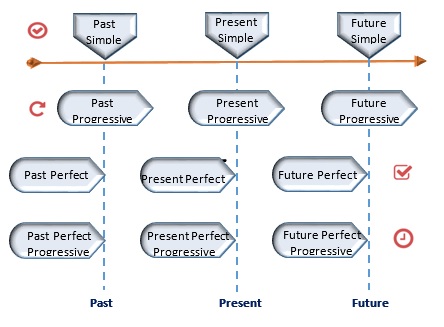
The verb tenses are distributed on a temporal axis (past, present and future) and are grouped according to their different aspects.
The past tense is used to describe an activity or an event that has happened in the past or a past state of being and needs to include a time marker for when the event or action took place.
The simple present tense or present tense is one of the most basic tenses in English. We use present tense to talk about something that is currently going on, something that is habitually performed, or a state that generally or currently exists.
The future tense is a verb tense used to describe an event or action that has not yet happened and is expected to happen in the future.

To make communication in English easier and simpler, we need to learn about tenses.
Apart from the three main types of tenses - present, past, and future - there are different subtypes of tenses :
The past continuous tense is used to describe events or actions that have already occurred in the past. It's employed to describe any action which has happened in the past.
The past perfect tense is used to describe an event that occurred before a completed action in the past.
The past perfect continuous tense represents any action or event that started in the past and sometimes continued into another action or another time.
The present continuous tense is used to talk about the ongoing actions, events, or conditions that are still not finished.
The present perfect tense is used to describe a situation or event that has already occurred but has immediate ramifications. The present perfect tense can be used to describe experiences, and situations that occurred in the past but still have an influence on the present. We don't use it with time markers.
The present perfect continuous tense shows a situation that has started in the past and continues in the present.
The future continuous tense is used to describe an ongoing action that will occur or occur in the future.
The future perfect is used to describe an action that will be completed between now and a certain point in the future.
We use the future perfect continuous to focus on the duration of an action before a specific time in the future.
This short extract shows how important the accurate use of tense is and how confusing it can be when tense is used inaccurately.
Telling the difference between times can take a long time. This is why it is advisable to practice the language on a regular and diligent basis to progress quickly.
Tenses are an important part of English grammar, they indicate when an action, event, thought, or feeling happened or will happen. Past, present, and future are the three main types of tenses.
Diagram of English tenses
The verb tenses are distributed on a temporal axis (past, present and future) and are grouped according to their different aspects.
Past tense
The past tense is used to describe an activity or an event that has happened in the past or a past state of being and needs to include a time marker for when the event or action took place.
Present tense
The simple present tense or present tense is one of the most basic tenses in English. We use present tense to talk about something that is currently going on, something that is habitually performed, or a state that generally or currently exists.
Future tense
The future tense is a verb tense used to describe an event or action that has not yet happened and is expected to happen in the future.
To make communication in English easier and simpler, we need to learn about tenses.
Apart from the three main types of tenses - present, past, and future - there are different subtypes of tenses :
Subtypes of tenses
Past continuous tense
The past continuous tense is used to describe events or actions that have already occurred in the past. It's employed to describe any action which has happened in the past.
Past perfect tense
The past perfect tense is used to describe an event that occurred before a completed action in the past.
Past perfect continuous tense
The past perfect continuous tense represents any action or event that started in the past and sometimes continued into another action or another time.
Present continuous tense
The present continuous tense is used to talk about the ongoing actions, events, or conditions that are still not finished.
Present perfect tense
The present perfect tense is used to describe a situation or event that has already occurred but has immediate ramifications. The present perfect tense can be used to describe experiences, and situations that occurred in the past but still have an influence on the present. We don't use it with time markers.
Present perfect continuous tense
The present perfect continuous tense shows a situation that has started in the past and continues in the present.
Future continuous tense
The future continuous tense is used to describe an ongoing action that will occur or occur in the future.
Future perfect tense
The future perfect is used to describe an action that will be completed between now and a certain point in the future.
Future perfect continuous tense
We use the future perfect continuous to focus on the duration of an action before a specific time in the future.
This short extract shows how important the accurate use of tense is and how confusing it can be when tense is used inaccurately.
Telling the difference between times can take a long time. This is why it is advisable to practice the language on a regular and diligent basis to progress quickly.