


English Grammar
Noun
A noun is a word that names an entity (person, animal, thing), a matter (substance), a place, a process (action, evolution) or an abstraction (idea, feelings, concept).
Nouns are the answer to the following questions Who is this ? What is that ? Where is that ?
Nouns are the answer to the following questions Who is this ? What is that ? Where is that ?
Examples:
1. Entity (person, animal, thing)
• Person: teacher, doctor, Sarah.
• Animal: dog, elephant, cat.
• Thing: table, computer, phone.
Examples in sentences:
• The teacher explained the lesson.
• A dog is barking outside.
• My computer is very fast.
• Animal: dog, elephant, cat.
• Thing: table, computer, phone.
Examples in sentences:
• The teacher explained the lesson.
• A dog is barking outside.
• My computer is very fast.
2. Matter (substance)
• water, gold, milk, wood, air
Examples in sentences:
• Water is essential for life.
• The ring is made of gold.
• We need more wood for the fire.
Examples in sentences:
• Water is essential for life.
• The ring is made of gold.
• We need more wood for the fire.
3. Place
• school, city, park, France, office
Examples in sentences:
• The children are at school.
• Casablanca is a large city.
• We walked through the park.
Examples in sentences:
• The children are at school.
• Casablanca is a large city.
• We walked through the park.
4. Process (action, evolution)
• growth, development, movement, discussion, construction
Examples in sentences:
• The development of technology is rapid.
• Their discussion lasted two hours.
• The growth of the plant was impressive.
Examples in sentences:
• The development of technology is rapid.
• Their discussion lasted two hours.
• The growth of the plant was impressive.
5. Abstraction (idea, feelings, concept)
• love, freedom, happiness, justice, knowledge
Examples in sentences:
• Love can change people.
• Everyone deserves freedom.
• Knowledge is power.
Examples in sentences:
• Love can change people.
• Everyone deserves freedom.
• Knowledge is power.

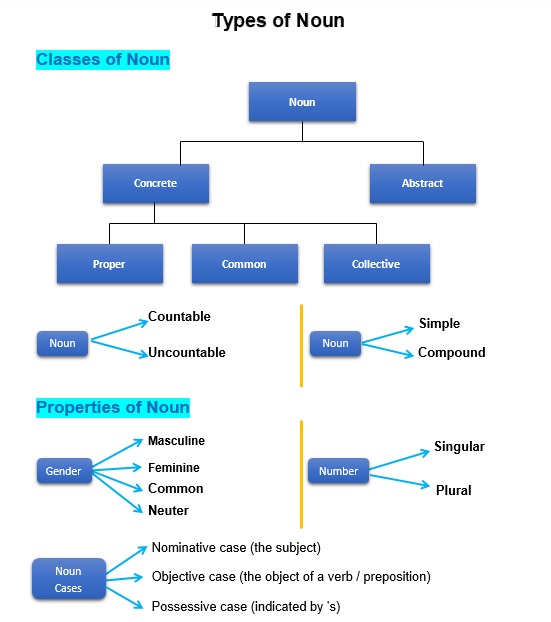
1) Classes of Noun |
|||
2) Properties of Noun |
|||
1) Classes of Noun
1.1) Concrete Noun
A concrete noun is a word used to describe a physical thing (a person, animal, thing, place, ideas..) that can be perceived by the senses : seen, touched, heard, smelled, or tasted.
Examples:
| boy | table | floor | coffee | ||
| beach | King | rain | children | ||
| fire | teeth | food | plane |
Example in a Sentence:
• The dog is sleeping under the table.

1.1.1) Proper Noun
A proper noun refers to a specific name. Generally, with few exceptions, it does not have a determiner and begins with a capital letter.
Examples:
| Ali | Alice | London | Sweden | |||
| Earth | Eiffel tower | Civil war | ||
Exception examples:
| The Netherlands | The United States | The United Kingdom | ||
| The Thames | The Atlantic Ocean | The Alps |
Example in a Sentence:
• Ahmed lives in Casablanca.
1.1.2) Common Noun
A common noun is a general and non-specific noun referring to a person, place, thing, or idea. It is written in lowercase, except at the beginning of a sentence, and is usually preceded by articles such as "the," "a," or "an".
Examples:
| boy | girl | city | country | ||
| company | planet | location | war |
Example in a Sentence:
• The teacher gave us homework today.
1.1.3) Collective Noun
Collective noun is name that refer to groups.
Examples:
| army | crowd | team | herd |
Example in a Sentence:
• The team won the football match.
1.1.4) Countable Noun
A countable noun is a noun that indicates something you could actually count.
For example, you could count pigs: one pig, two pigs, three pigs...
However, you couldn't count water: one water, two water – no, it doesn't work....
A countable noun has both a singular and a plural form, and it can be used with the indefinite articles (a/an).
Examples:
| window | teacher | tree | eye | ||
| cloud | pencil | heart | Movie |
We use “How many” + plural or countable (that we can count)
Examples:
| apples | children | books | planes | ||
| people | dogs | pens | cars |
Example in a Sentence:
• I bought three books yesterday..
1.1.5) Uncountable Noun
Uncountable nouns represent things that we cannot count with numbers. These nouns often denote abstract ideas or qualities, or physical objects that are too small or fluid to be counted individually (liquids, powders, gases, etc.). Uncountable nouns require a singular verb. Often these nouns do not have a plural.
An uncountable noun has only one form (no plural), and it cannot be used with the indefinite articles (a/an).
Examples:
| gold | milk | Furniture | advice | ||
| equipment | luggage | work |
We use “How much” + singular or uncountable (that we can not count).
Examples:
| water | money | food | petrol |
Example in a Sentence:
• We need more water after the game.
1.1.6) Simple Noun
A simple name is a name consisting of a single word.
Examples:
| time | people | number | house |
Example in a Sentence:
• The child is playing outside.
1.1.7) Compound Noun
A compound noun is a noun that is made with two or more words. A compound noun is usually [noun + noun] or [adjective + noun].
Compound nouns can also be formed using the following combinations of words :
| Noun | + | Noun | toothpaste | ||
| Adjective | + | Noun | monthly ticket | ||
| Verb | + | Noun | swimming pool | ||
| Preposition | + | Noun | underground | ||
| Noun | + | Verb | haircut | ||
| Noun | + | Preposition | hanger on | ||
| Adjective | + | Verb | dry-cleaning | ||
| Preposition | + | Verb | output |
The two parts may be written in a number of ways :
a. Sometimes the two words are joined together.
Example: tooth + paste = toothpaste | bed + room = bedroom
b. Sometimes they are joined using a hyphen.
Example: check-in
c. Sometimes they appear as two separate words.
Example: full moon
Example in a Sentence:
• My toothbrush is in the bathroom.
1.2) Abstract Noun
They are names of nonphysical things that cannot be perceived: seen, touched, heard, smelled, or tasted.
Examples:
| hope | courage | fear | ||
| interest | love | peace | ||
| ability | success | knowledge | ||
| joy | lies | truth | faith |
Example in a Sentence:
• Honesty is very important in friendship.
2) Properties of Noun
2.1) Noun Gender
Every noun is provided with a genus which is proper to it, and which it retains in all its uses; this gender can be determined by sex if it is an animated being (a man / a woman; a cat / a cat); but most of the time it is perfectly arbitrary, and fixed by usage.
The Noun-Gender tells us about the sex of the noun.
| In Grammar Noun, there are four genders : | |||||
| Masculine | Feminine | Common | Neuter | ||
|---|---|---|---|---|---|
2.1.1) Masculine gender :
A noun is said to be in the Masculine gender if it refers to a male character or member of a species.
Examples:
| man | lion | hero | boy | ||
| king | horse | actor |
Example in a Sentence:
• The king spoke to his people.
2.1.2) Feminine gender :
A noun is said to be in the feminine gender if it refers to a female member of a species.
Examples:
| woman | lioness | girl | mare | ||
| niece | cow | actress |
Example in a Sentence:
• The actress won an important award.
2.1.3) Common gender :
A noun is said to be in Common gender if it refers to a member of species which can be a male or a female.
Examples:
| child | student | friend | applicant | ||
| candidate | servant | member |
Example in a Sentence:
• The teacher explained the lesson clearly.
2.1.4) Neuter gender :
A noun is said to be in the neuter gender if it refers to a member of a species which is neither a male nor a female.Normally nouns referring to lifeless objects are in neuter nouns.
Examples:
| chair | table | tree | star | ||
| street | book | car | school |
Example in a Sentence:
• The computer stopped working suddenly.
2.2) Noun Number
In English grammar, when you refer to one noun, it is considered singular. When you refer to more than one noun, it is considered plural.
2.2.1) The Singular Noun
Singular Nouns: Represent a single person, place, thing, or concept (e.g., cat, book, city).
2.2.2 The Plural Noun
Plural Nouns: Represent two or more of a kind (e.g., cats, books, cities).
Regular Plurals: Generally formed by adding -s (e.g., dog --> dogs) or -es for words ending in -s, -ss, -sh, -ch, -x, or -z
(e.g., box --> boxes).
Irregular Plurals: These do not follow standard rules and often change spelling (e.g., man --> men, child --> children).
Some remain the same in both forms (e.g., sheep --> sheep, deer --> deer).
Compound Nouns: Often pluralized by adding -s to the main word (e.g., mother-in-law --> mothers-in-law).
Exceptions:
Nouns ending in -y: If preceded by a consonant, change -y to -ies (e.g., baby --> babies).
Nouns ending in -f or -fe: Often change to -ves (e.g., knife --> knives).
Uncountable Nouns: Nouns that represent concepts or substances that cannot be counted, such as information, water, or furniture, generally do not have a plural form.
Plural-Only Nouns: Some items that have two parts are always used in the plural, such as scissors, glasses, and trousers.
Nouns ending in -f or -fe: Often change to -ves (e.g., knife --> knives).
Uncountable Nouns: Nouns that represent concepts or substances that cannot be counted, such as information, water, or furniture, generally do not have a plural form.
Plural-Only Nouns: Some items that have two parts are always used in the plural, such as scissors, glasses, and trousers.
Examples:
| The chart below shows the usual changes needed to make nouns plural in English | |||||
|---|---|---|---|---|---|
| Type of Noun | Plural Rule | Singular Noun | Plural Noun | ||
| most nouns | add s | cat | cats | ||
| student | students | ||||
| noun ending in vowel + o | add s | video | videos | ||
| radio | radios | ||||
| noun ending in vowel + y | add s | toy | toys | ||
| day | days | ||||
| noun ending in ch, sh, s, x, z | add es | church | churches | ||
| bench | benches | ||||
| brush | brushes | ||||
| dish | dishes | ||||
| class | classes | ||||
| kiss | kisses | ||||
| fox | foxes | ||||
| topaz | topazes | ||||
| buzz | buzzes | ||||
| noun ending in consonant + o | add es | potato | potatoes | ||
| echo | echoes | ||||
| noun ending in consonant + y | drop y and add ies | baby | babies | ||
| army | armies | ||||
| noun ending in f or fe | change f or fe to ves | thief | thieves | ||
| life | lives | ||||
| irregular nouns that change | varies | man | men | ||
| woman | women | ||||
| child | children | ||||
| mouse | mice | ||||
| foot | feet | ||||
| tooth | teeth | ||||
| irregular nouns that stay the same | no change | deer | deer | ||
| sheep | sheep | ||||
| fish | fish | ||||
| compound nouns | add s to the main noun | brother-in-law | brothers-in-law | ||
| secretary of state | secretaries of state | ||||
| noun ending in is (usually from Greek) | change is to es | analysis | analyses | ||
| crisis | crises | ||||
| thesis | theses | ||||
| paralysis | paralyses | ||||
| basis | bases | ||||
| noun ending in us (usually from Latin) | change us to i | cactus | cacti | ||
| syllabus | syllabi | ||||
| fungus | fungi | ||||
| stimulus | stimuli | ||||
| noun ending in um | change um to a | bacterium | bacteria | ||
| medium | media | ||||
| plural noun having no singular forms | no change | news | news | ||
| scissors | scissors | ||||
| pajamas | pajamas | ||||
| pants | pants | ||||
| eyeglasses | eyeglasses | ||||
Example in a Sentence:
Singular Noun :
• The cat is sleeping on the sofa.
Plural Noun :
• The cats are sleeping on the sofa.
• The cat is sleeping on the sofa.
Plural Noun :
• The cats are sleeping on the sofa.
2.3) Noun Cases
2.3.1) Nominative case (the subject)
The noun acts as the subject of a sentence.
2.3.2) Objective case (the object of a verb/preposition)
The noun acts as the direct object, indirect object, or object of a preposition.
2.3.3) Possessive Case
Genitive case signals a relationship of possession or “belonging to.” In English, possession is usually shown by either an ending (apostrophe + s) or with the preposition “of.”
my brother's dog ------> the dog of my brother
| Masculine | Feminine | Neuter | |||
|---|---|---|---|---|---|
| definite article | (the man’s book) | (the woman’s book) | (the girl’s book) | ||
| indefinite article | (a man’s book) | (a woman’s book) | (a girl’s book) | ||
| Plural | |||||
| definite article | (the women’s books) | ||||
| indefinite article | (no women’s books) |
Also called the possessive case, the genitive case is when we add apostrophe S (’s) to show possession, that something belongs to another or a type of relationship between things.
e.g. Woodward’s house, Your brother’s friend.
e.g. Woodward’s house, Your brother’s friend.
Example in a Sentence:
• Sara’s bag is on the chair.
Apostrophe S Summary Chart
WHAT IS THE APOSTROPHE S?
The Apostrophe S normally used to show possession, that there is a relationship between two things or that something belongs to another.
The Apostrophe S normally used to show possession, that there is a relationship between two things or that something belongs to another.
• John's car (=The car of John. The car belongs to John)
SINGULAR NOUNS
Add -'s
Add -'s
• We went to Ange's house last night.
• Have you seen the dog's bone?
• Have you seen the dog's bone?
PLURAL NOUNS ENDING IN -S
Only add the apostrophe -'
Only add the apostrophe -'
• I went to my friends'party. (=the party of your friends)
• My cousins'house is always a mess. (=your cousins)
• My cousins'house is always a mess. (=your cousins)
PLURAL NOUNS NOT ENDING IN -S
Add -'S
Add -'S
• The children's toys are all over the room.
• The men's toilet was disgusting.
• The men's toilet was disgusting.
SINGULAR NOUNS ENDING IN -S
Add -'S
Add -'S
• The actress's role was very difficult.
• Mr Lewis's dog always comes onto our property.
• Mr Lewis's dog always comes onto our property.
AS A PART OF A PHRASE
Add -'S or only -' depending on the rules above
Add -'S or only -' depending on the rules above
• The President of Chile's speech was too long.
• I had to give two weeks'notice I was leaving.
• I had to give two weeks'notice I was leaving.
NO NOUN
Sometimes the noun after -'S is not necessary when the meaning is clear
Sometimes the noun after -'S is not necessary when the meaning is clear
• My car is older than John's. (=John's car)

3) Uses of Noun
Nouns can act as the subjects (doing the action), direct/indirect objects (receiving the action), complements (defining the subject or object) , objects of prepositions, appositives, or modifiers in sentences.
- Subject of a Sentence: Identifies who or what performs the action.
- Example: The dog barked.
- Direct Object: Identifies who or what receives the action of a transitive verb.
- Example: She bought a book.
- Indirect Object: Identifies to whom or for whom the action is done.
- Example: I gave Maria the keys.
- Object of a Preposition: Follows a preposition to create a phrase.
- Example: The cat is under the table.
- Predicate Noun (Subject Complement): Follows a linking verb to rename or identify the subject.
- Example: He is a teacher.
- Object Complement: Describes or renames the direct object.
- Example: They elected her president.
- Appositive: Renames or provides more information about another noun beside it.
- Example: My friend Sarah lives here.
- Modifiers (Adjectival Usage): Nouns that function as adjectives to describe other nouns.
- Example: We bought a coffee machine.
- Direct Address: Used to call someone’s attention directly.
- Example: Please sit down, John.
Kinds of nouns exercises
Answers
1. The book was lying on the table. (book – common noun; table – common noun)
2. Love begets love. (love – abstract noun)
3. We cannot live without water. (water – material noun)
4. The jury has given its verdict. (jury – collective noun; verdict – abstract noun)
5. The Hindus regard Krishna as an incarnation of Lord Vishnu. (Hindus – proper noun; Krishna – proper noun; incarnation – common noun; Vishnu – proper noun)
6. Alcohol is injurious to health. (alcohol – material noun; health – abstract noun)
7. Smoking is a bad habit. (habit – abstract noun)
8. Wild animals live in forests. (animals – common noun; forests – common noun)
9. The childhood of Peter was full of misery. (childhood – abstract noun; Peter – proper noun; misery – abstract noun)
10. All the girls were singing. (girls – common noun)
11. Gold is a precious metal. (Gold – material noun; metal – common noun)
12. Rice is the staple food of South Indians. (rice – material noun; food – common noun; Indians – proper noun)
13. The earth moves round the sun. (earth – common noun; sun – common noun)

