


Before studying the basics of English grammar, it is best to master certain prerequisites.
Essential information to know:
Essential information to know:
Parts of a sentence
Part 1
The basic structure of a sentence
Sentence :
A sentence is a group of words arranged in a grammatical order and having
a complete meaning, typically containing a subject (who/what) and
a predicate (what the subject is/does). In writing,
a sentence must begin with a capital letter and end with a period (.),
question mark (?), or exclamation mark (!), depending on its type.
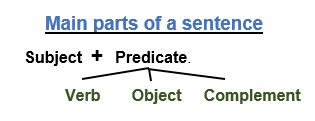
Predicate :
A predicate is the part of a sentence or clause that contains
the verb and tells us what the subject does, is, or feels.
It typically follows the subject and includes the verb along with any objects,
modifiers, or complements.
For example:
- Spain is in Europe.
What about Spain? It is in Europe.
Predicate = is in Europe - Traveling is fun
What about traveling? It is fun.
Predicate = is fun - There is a mouse in the room.
What about the mouse? It is in the room.
Predicate = is in the room
Phrase :
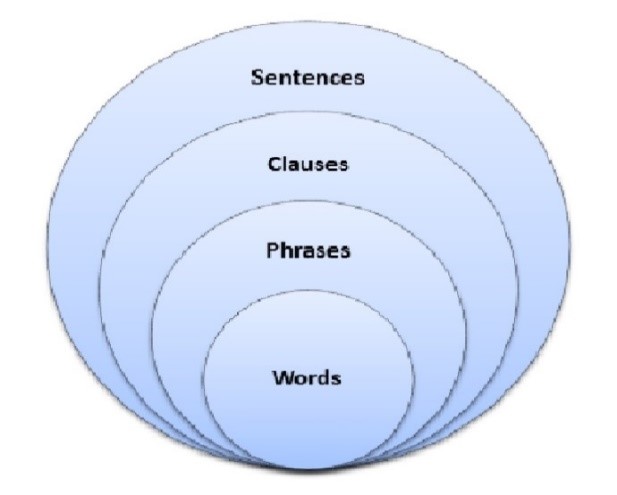
A phrase is one or more words that can be grouped together,
but without a subject or a verb. There are five main types of phrase in English :
Noun phrase : a red box.
Verb phrase : will go.
Adjective phrase : quite big.
Adverb phrase : very slowly.
Prepositional phrase : in the car.
Verb phrase : will go.
Adjective phrase : quite big.
Adverb phrase : very slowly.
Prepositional phrase : in the car.
Example:
"The little girl [noun phrase] ran swiftly [verb phrase]
across the playground [prepositional phrase]."
Clauses :
A clause in English grammar is a group of words containing a subject and
a predicate, acting as a fundamental building block of sentences.
Clauses are classified into independent (can stand alone) and
dependent / subordinate (rely on another clause, cannot stand alone).
They can function as nouns, adjectives, or adverbs.
1. The Independent Clause (The "Main" Clause)
An independent clause is a complete thought. It contains both a subject (who or what the sentence is about) and a verb (the action or state of being), and it makes perfect sense all on its own.
2. The Dependent Clause (The "Subordinate" Clause)
A dependent clause also contains a subject and a verb. However, it is an incomplete thought because it starts with a connecting word (a subordinating conjunction or relative pronoun). It relies on an independent clause to make sense.
• Common Subordinating Words:
• Example:
How to Combine Them ?
To build clear, professional sentences, you can attach a dependent clause to an independent clause.
Rule: Dependent + Independent
When the dependent clause comes first, you must separate it from the independent clause with a comma.
• Because the traffic was heavy, the train arrived late.
An independent clause is a complete thought. It contains both a subject (who or what the sentence is about) and a verb (the action or state of being), and it makes perfect sense all on its own.
• Structure: Subject + Verb
• Example:
• Example:
- The train arrived on time.
- She drank a cup of coffee.
2. The Dependent Clause (The "Subordinate" Clause)
A dependent clause also contains a subject and a verb. However, it is an incomplete thought because it starts with a connecting word (a subordinating conjunction or relative pronoun). It relies on an independent clause to make sense.
• Common Subordinating Words:
because, although, since, when, if, while, until
• Example:
- Because the traffic was heavy.
- When the bell rang.
How to Combine Them ?
To build clear, professional sentences, you can attach a dependent clause to an independent clause.
Rule: Dependent + Independent
When the dependent clause comes first, you must separate it from the independent clause with a comma.
• Because the traffic was heavy, the train arrived late.
The structure of sentences will be developed in detail in : "The parts of a sentence - Part 2". .
Components of a sentence :
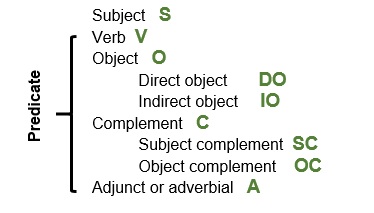
Like a sentence has two parts, it has five main components that make up the structure of a sentence, and they are :
Subject
The subject can be a noun or a pronoun that does the action. A subject can be identified by asking the question "who?". It takes the first place in most cases, especially in declarative or assertive sentences.
Verb
A verb shows action or activity or work done by the subject. Remember that all verbs including main verbs, helping verbs, stative verbs and action verbs come under this category. Most often, verbs appear immediately after the subject.
Object
An object is a noun or pronoun that receives the action done by the subject. Objects are of two types and they are,
Complement
A complement is a word, phrase, or clause that completes the meaning of another part of a sentence. Without it, the sentence may feel incomplete or unclear.
In a sentence, there can be two types of complements, namely :
Adjunct
Adjuncts are optional words, phrases, or clauses (often adverbials) that add context like time, place, or manner and that there can be more than one adjunct in a sentence.. They are highly flexible and can be placed at the beginning (initial), middle (medial), or end (terminal) of a sentence. Adjuncts can be identified by asking questions "when", "where", "why", "how", "how often" and "to what extent".
Like a sentence has two parts, it has five main components that make up the structure of a sentence, and they are :
• Subject
• Verb
• Object
• Complement
• Adjunct
• Verb
• Object
• Complement
• Adjunct
Subject
The subject can be a noun or a pronoun that does the action. A subject can be identified by asking the question "who?". It takes the first place in most cases, especially in declarative or assertive sentences.
For example:
- The sun is shining.
- The sky is clear.
- Today is Wednesday.
- The child kept crying.
- Our school team won the match.
- My son is in the eighth grade.
- Hard work pays.
- No one came to the wedding.
Verb
A verb shows action or activity or work done by the subject. Remember that all verbs including main verbs, helping verbs, stative verbs and action verbs come under this category. Most often, verbs appear immediately after the subject.
For example:
- Neena is writing a letter.
- It was too dark.
- I feel tired.
- My phone is not working.
- Tarun’s dog ran away.
Object
An object is a noun or pronoun that receives the action done by the subject. Objects are of two types and they are,
• Direct Object
• Indirect Object
• Indirect Object
Direct Object
A noun or pronoun that receives the action directly is the direct object in the sentence. It answers the question "what?". Direct objects mostly appear immediately after the verb and are the primary objects in the sentence.
Indirect Object
An indirect object is a noun or pronoun that is a secondary object. It can be identified by asking the question "whom?". When there is an indirect object in a sentence, it is mostly placed after the verb and before the direct object.
A noun or pronoun that receives the action directly is the direct object in the sentence. It answers the question "what?". Direct objects mostly appear immediately after the verb and are the primary objects in the sentence.
For example:
- Harry bought a new car.
- My mom made a cake.
- I met my friend.
- She knows all the songs.
- We watched a movie.
Indirect Object
An indirect object is a noun or pronoun that is a secondary object. It can be identified by asking the question "whom?". When there is an indirect object in a sentence, it is mostly placed after the verb and before the direct object.
For example:
- Vandhana gave Keerthana a cake.
- My mom bought me a new dress.
- I gave him a chocolate.
- They gave us coffee with breakfast.
- He lent his friend a pen.
Complement
A complement is a word, phrase, or clause that completes the meaning of another part of a sentence. Without it, the sentence may feel incomplete or unclear.
For example:
- It grew dark.
- He is a dentist.
- That’s her dog, Bruno.
In a sentence, there can be two types of complements, namely :
• Subject Complement
• Object Complement
• Object Complement
Subject Complement
A subject complement renames, identifies, or describes the subject. It follows linking verbs (such as is, seems, feels, becomes).
Linking verbs list :
be, become, seem, appear, remain, feel, look, smell, sound, taste, stay, grow, turn, prove, have, had, has, do, did, does, will, would.
Object Complement
An object complement renames or describes a direct object. It follows action verbs (such as name, call, elect, paint).
An object complement follows the object and gives more details about it.
A subject complement renames, identifies, or describes the subject. It follows linking verbs (such as is, seems, feels, becomes).
Linking verbs list :
be, become, seem, appear, remain, feel, look, smell, sound, taste, stay, grow, turn, prove, have, had, has, do, did, does, will, would.
For example:
- "She is a doctor." (Noun phrase "a doctor" renaming the subject "She")
- "The soup smells delicious." (Adjective "delicious" describing the subject "The soup")
- "He seems tired." (Adjective "tired" describing the subject "He")
Object Complement
An object complement renames or describes a direct object. It follows action verbs (such as name, call, elect, paint).
An object complement follows the object and gives more details about it.
For example:
- "They named their dog Bruno." (Noun "Bruno" renaming the direct object "dog")
- "We painted the wall blue." (Adjective "blue" describing the direct object "wall")
- "The committee elected her chairperson." (Noun "chairperson" renaming the direct object "her")
Adjunct
Adjuncts are optional words, phrases, or clauses (often adverbials) that add context like time, place, or manner and that there can be more than one adjunct in a sentence.. They are highly flexible and can be placed at the beginning (initial), middle (medial), or end (terminal) of a sentence. Adjuncts can be identified by asking questions "when", "where", "why", "how", "how often" and "to what extent".
For example:
- Initial (Beginning): Sets the scene or context. Often followed by a comma, especially if the adjunct is long.
Example:
- After the match, we went home.
- In the morning, he jogs.
- Medial (Middle): Placed between the subject and verb, or between the verb and complement, often providing manner or frequency.
Example:
- They quickly accepted the offer.
- He always eats breakfast.
- Terminal (End): The most common, default position for most adjuncts, especially those describing place or time.
Example:
- I will meet you at the park.
- She sang beautifully.
Placement of the constituent elements of a sentence :
Sentences are built from structural building blocks called constituents, such as subjects, verbs, objects, and adverbials. In English, these constituents are primarily placed in a standard Subject-Verb-Object (SVO) order to convey a complete idea.
Placement of the sentence complement:
Sentences are built from structural building blocks called constituents, such as subjects, verbs, objects, and adverbials. In English, these constituents are primarily placed in a standard Subject-Verb-Object (SVO) order to convey a complete idea.
| Subject | verb | Indirect Object | Direct object |
Placement of the sentence complement:
• Subject Complement: Placed after a linking verb (e.g., "is," "seems," "becomes"), defining or describing the subject.
• Object Complement: Placed immediately after the direct object, describing or renaming it.
| Subject | verb | Subject Complement |
- Structure: Subject + Linking Verb + Subject Complement.
- Examples:
- "She is a doctor." (Noun phrase)
- "He seems angry." (Adjective)
• Object Complement: Placed immediately after the direct object, describing or renaming it.
| Subject | verb | Direct Object | Object Complement |
- Structure: Subject + Verb + Direct Object + Object Complement.
- Examples:
- "Call me paranoid." (Adjective)
- "They made him president." (Noun)
Sentence Patterns
English sentence patterns are the fundamental structures—mainly Subject-Verb-Object (SVO)—that arrange words to create coherent meaning.
The Different Types of Sentence Structures in English Grammar
English sentence patterns are the fundamental structures—mainly Subject-Verb-Object (SVO)—that arrange words to create coherent meaning.
The Different Types of Sentence Structures in English Grammar
In English grammar, there are a number of sentence structures that you can use to make your speech or writing sound or look a lot more organised, interesting and professional.
Examples of common structures :

Examples of common structures :
• Subject + Verb (SV)
• Subject + Verb + Object (SVO)
• Subject + Verb + Complement (SVC)
• Subject + Verb + Adjunct (SVA)
• Subject + Verb + Object + Complement (SVOC)
• Subject + Verb + Object + Adjunct (SVOA)
• Subject + Verb + Indirect Object + Direct Object (SVIODO)
• Adjunct + Subject + Verb + Complement (ASVC)
• Adjunct + Subject + Verb + Object (ASVO)
• Adjunct + Subject + Verb + Indirect Object + Direct Object (ASVIODO)
• Subject + Verb + Adjunct + Adjunct (SVAA)
• Adjunct + Subject + Verb + Adjunct + Adjunct (ASVAA)
• Subject + Verb + Object (SVO)
• Subject + Verb + Complement (SVC)
• Subject + Verb + Adjunct (SVA)
• Subject + Verb + Object + Complement (SVOC)
• Subject + Verb + Object + Adjunct (SVOA)
• Subject + Verb + Indirect Object + Direct Object (SVIODO)
• Adjunct + Subject + Verb + Complement (ASVC)
• Adjunct + Subject + Verb + Object (ASVO)
• Adjunct + Subject + Verb + Indirect Object + Direct Object (ASVIODO)
• Subject + Verb + Adjunct + Adjunct (SVAA)
• Adjunct + Subject + Verb + Adjunct + Adjunct (ASVAA)
Swipe left/Right
Sentence Structure Examples
- S+V+IO+DO: "She gave her dog a treat."
- S+V+DO+OC: "They found the movie boring."
- S+V+O+A: "The team completed the project successfully."
- A+S+V+O: "Yesterday, I bought a car."
The structure of sentences will be developed in detail in : "The parts of a sentence - Part 2". .

